Earnings Watch: Q2 Earnings Strength Extends Beyond Mega-Cap Tech
More sectors contributed to growth, including energy, banks and industrial suppliers.

Key Takeaways
AI-related demand boosted hyperscalers and chipmakers while supporting firms tied to data center buildouts.
Companies benefited from resilient demand, pricing power and productivity gains despite cost pressures.
Outlooks remained largely upbeat, supporting forecasts of continued profit gains later this year.
Earnings growth surged in the second quarter as artificial intelligence (AI), broadening growth and resilient demand all contributed to results. Faster growth and better-than-expected earnings were seen across regions.
The S&P 500® Index was on track for about 50% earnings growth, its best performance since 2021. Alphabet and Amazon were major contributors, but a significant part of their gains stemmed from the rising value of their equity holdings, including shares in Anthropic.1
Excluding those two companies, the S&P 500’s blended growth rate stood at 32% – marking the seventh consecutive quarter of double-digit growth.2
We believe the strength of this earnings season reaffirms our constructive outlook for the year, even amid investor uncertainty about AI and the conflict in Iran.
Among this quarter’s highlights:
Japanese earnings growth jumped, as roughly 80% of companies beat analysts’ estimates.3 The strongest sectors included energy, materials and information technology. Communication services and utilities were areas of weakness.
Emerging markets also saw accelerating earnings growth, drawing on strength in information technology, energy and materials.4 Consumer discretionary and utilities were weaker.
Most S&P 500 companies beat analysts’ estimates.5 Energy, communication services and consumer discretionary were strong, while real estate and health care were the weakest.
Europe was also on pace for higher earnings growth, led by energy, real estate and utilities.6 Consumer staples and consumer discretionary were the weakest sectors.
To gain a deeper understanding of the current market conditions and future expectations, explore our latest Investment Outlook.
Five Trends That Shaped Q2 2026 Earnings

1. AI Remained a Key Earnings Growth Driver
Artificial intelligence remained a dominant driver of earnings growth, with hyperscaler firms such as Alphabet, Amazon and Microsoft reporting higher AI-related revenues.
Alphabet, for example, said its cloud revenue grew 82% year over year, primarily driven by AI-related demand. Revenue grew 17% for its “search & other” unit as more people use Google’s AI Overviews and AI Mode.7
“Our AI investments are redefining what’s possible across every part of our business,” said Alphabet CEO Sundar Pichai.
Beyond the hyperscalers, semiconductor companies were on track to post triple-digit earnings growth for the quarter.8 Demand remained strong for companies in memory, networking and data centers, as well as for industrial firms involved in data center construction and electrification.
But earnings season also showed that investors remain focused on the cost of building AI infrastructure and want to see clear returns on that spending. Meta's shares fell after the company reported sharply lower free cash flow and reiterated its capital spending plans.9
2. Energy and Financials Helped Fuel Earnings Growth
Energy recorded some of the sharpest gains in earnings and revenues during the second quarter. The Strait of Hormuz’s closure sent oil prices higher, driving robust demand for producers, refiners and other companies.
Chevron, the global gas and oil company, reported earnings of $12.1 billion, up from $2.5 billion a year earlier.10 It also ranked among the company’s best quarters ever for oil production.11
The financials sector saw higher-than-expected earnings growth.12 Banks in the U.S. and Europe benefited from higher capital markets activity, while higher interest rates and resilient loan demand helped Japanese institutions.
Citigroup, for example, reported a 44% revenue jump in its investment banking unit, citing its role in IPOs for companies like SpaceX and Cerebras.13
Sumitomo Mitsui Financial Group, a Japan-based bank, saw its net business profit rise by 30% compared to a year earlier. Business customers were a particular source of strength, generating most of the growth in loan balances.14
Select consumer-facing industries also made progress, including travel and leisure.
3. Business and Consumer Demand Remained Resilient
AI is fueling higher corporate spending, not just among the hyperscalers. Companies across a wider range of industries – financials, industrials, consumers – are also putting resources into AI-related initiatives.
For example, Datadog, a provider of cloud monitoring and security software, reported higher revenue as more businesses sign up for its services.
“Our customers are building and deploying with AI, and they are using the Datadog platform to observe, secure and act on their AI-enabled solutions,” CEO Olivier Pomel said.15
Meanwhile, credit card companies cited resilient consumer spending. American Express said U.S. consumer spending was up 11%, the highest growth rate since early 2018, excluding the pandemic.
“The macro environment remains supportive,” Mastercard CEO Michael Miebach said. “Consumers and businesses are healthy and continue to spend, supported by positive job growth, low unemployment and real purchasing power in many major economies.”16
4. Margin Expansion Became a Significant Earnings Driver
The S&P 500 logged a very strong net profit margin, even excluding Amazon and Alphabet’s above-normal results.17 In Europe, several sectors – including energy, real estate and utilities – saw earnings growth that outpaced sales growth, FactSet noted.18
Businesses used pricing power, operating leverage and productivity gains to compensate for inflation, tariffs and other constraints.
SK Hynix, the South Korea-based chipmaker, said its operating margin rose from 41% a year ago to 76% during the second quarter as more companies sought out its memory chips, particularly its high-value-added products.19
Société Générale, the France-based investment bank that has prioritized efficiency in recent years, said its costs fell 4.1% compared to a year earlier.20
“These strong results, delivered in a highly uncertain and volatile environment, demonstrate the success of our transformation over the past three years,” said CEO Slawomir Krupa. “Today, we are much more efficient, focused and profitable with a well-diversified business mix.”
5. Company Guidance Trended Positive
Positive guidance outnumbered negative forecasts for the third quarter and for the rest of 2026, FactSet noted.21
Continued momentum in AI-related spending led some companies to raise their guidance for the year.
Data analytics firm Palantir, which helps enterprises use AI more effectively, lifted its revenue guidance after reporting 93% year-over-year revenue growth, its best ever. Revenues from the U.S. alone rose 115%.22
Firms in other sectors, such as Eli Lilly and Co., issued stronger outlooks as well.23
As one executive noted on Lilly’s recent earnings call, the use of obesity drugs appears relatively low compared with the potential market. “And so there’s still a significant opportunity ahead of us to capture more patients,” said Ilya Yuffa, executive vice president.
Earnings Forecasts Point to Continued Growth for the Rest of 2026
Analysts forecast 44.95% earnings growth for emerging markets in the third quarter and 49.28% for the full calendar year. They also expect S&P 500 earnings growth of 27.73% in the third quarter and 31.04% for the year, with stronger growth anticipated across market capitalization sizes.24 See Figure 1.
Figure 1 | Earnings Estimates Trend Higher for All Cap Sizes
Change in Analysts’ Next 12-Month S&P Earnings Estimates
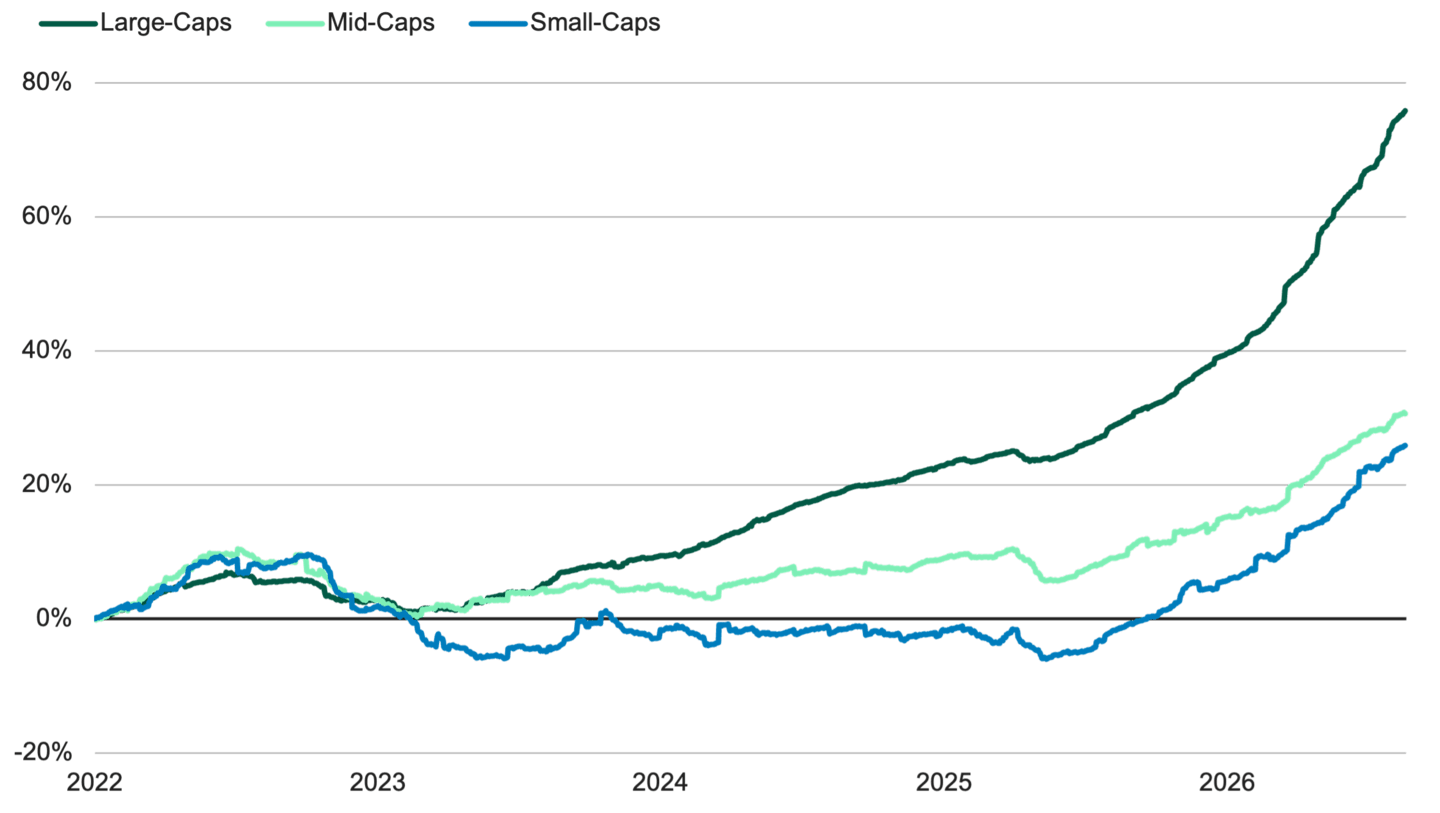
Data from 1/3/2022 – 8/21/2026. Source: Bloomberg. The S&P 500® Index represents large-caps. The S&P MidCap 400® Index represents mid-caps. The S&P SmallCap 600® Index represents small-caps. Past performance is no guarantee of future results.
Forecasts call for European earnings growth of 20.60% in the third quarter and 18.11% for the year. Japan’s earnings growth is forecast to decline 5.54% in the third quarter but to reach 16.75% for the year.25
Authors
Senior Client Portfolio Manager
Senior Client Portfolio Manager
Learn More About Our Global Growth Strategies
We focus on investing in companies with accelerating growth characteristics and earnings power.
John Butters, Earnings Insight, FactSet, August 7, 2026; Alphabet Inc., Q2 2026 earnings call, July 22, 2026; Amazon.com Inc., Q2 2026 Financial Results Conference Call Slides, July 30, 2026.
John Butters, Earnings Insight, FactSet, August 7, 2026.
FactSet, MSCI Japan, as of August 20, 2026.
FactSet, MSCI Emerging Markets, as of August 20, 2026.
FactSet, S&P 500, as of August 20, 2026.
FactSet, EM Europe, as of August 20, 2026.
Alphabet, Q2 2026 Earnings Call, July 22, 2026.
John Butters, Earnings Insight, FactSet, August 7, 2026.
Meghan Bobrowsky, “Meta Stock Drops 10% on Steeper AI Costs, Missed Forecast,” Wall Street Journal, July 29, 2026.
Chevron, “Chevron Reports Second Quarter 2026 Results,” Press Release, July 31, 2026.
Chevron, Q2 2026 Earnings Call, July 31, 2026.
John Butters, Earnings Insight, FactSet, August 7, 2026.
Citigroup Inc., Q2 2026 Earnings Call, July 14, 2026.
Sumitomo Mitsui Financial Group, Overview of 1Q FY3/2027, July 31, 2026.
Datadog, “Datadog Announces Second Quarter 2026 Financial Results,” News Release, August 6, 2026.
Mastercard, Q2 2026 Earnings Call, July 30, 2026.
John Butters, Earnings Insight, FactSet, August 7, 2026.
FactSet, “STOXX 600: Solid but Uneven Q2 Delivery as Energy Powers Growth and Technology Leads Beats,” August 7, 2026.
SK Hynix, “SK Hynix Announces 2Q26 Financial Results,” Earnings Report, July 29, 2026.
Société Générale, Q2 2026 Earnings Call, July 30, 2026.
John Butters, Earnings Insight, FactSet, August 7, 2026.
Palantir Technologies, Q2 2026 Earnings Call, August 3, 2026.
Eli Lilly, Q2 2026 Earnings Call, August 5, 2026.
FactSet, as of August 20, 2026.
FactSet, as of August 20, 2026.
Forecasts are not a reliable indicator of future performance.
The opinions expressed are those of American Century Investments (or the portfolio manager) and are no guarantee of the future performance of any American Century Investments portfolio. This material has been prepared for educational purposes only. It is not intended to provide, and should not be relied upon for, investment, accounting, legal or tax advice.
The information is not intended as a personalized recommendation or fiduciary advice and should not be relied upon for investment, accounting, legal or tax advice.
References to specific securities are for illustrative purposes only and are not intended as recommendations to purchase or sell securities. Opinions and estimates offered constitute our judgment and, along with other portfolio data, are subject to change without notice.
No offer of any security is made hereby. This material is provided for informational purposes only and does not constitute a recommendation of any investment strategy or product described herein. This material is directed to professional/institutional clients only and should not be relied upon by retail investors or the public. The content of this document has not been reviewed by any regulatory authority.
©2026 Standard & Poor's Financial Services LLC. The S&P 500® Index is composed of 500 selected common stocks most of which are listed on the New York Stock Exchange. It is not an investment product available for purchase.